

What Matters Most in E&S Carriers

Introduction
In the Excess and Surplus (E&S) market, you're often placing coverage for complex risk. In excess placements, losses can sit for years, pick up complexity as they move through the system, and then surface all at once, usually when there is real money on the line and several parties involved.
That's what makes carrier selection different here. You're weighing pricing and structure across the tower and making a judgment call on who will actually perform when things get complicated, long after the policy is bound.
Most conversations still default to premium first, which is understandable but misses the point. In the E&S market, that trade-off is a risk decision. In reality, two factors can have an outsized influence on whether a placement holds: the strength of the carrier’s balance sheet and who controls the claim when it surfaces. Everything else matters far less when things go sideways.
Financial Strength: More Than a Rating
Financial strength ratings serve as one of the few objective signals of whether a carrier can stand behind its obligations over time.
In E&S, that time horizon is where things break. Claims do not resolve cleanly or quickly. They evolve. They stretch across years. They pick up legal complexity, and sometimes they deteriorate before they improve. A carrier can look stable in a calm environment and still struggle once you layer in prolonged litigation, reserve pressure, or multiple large losses hitting at the same time.
At that point, financial strength stops being theoretical. It becomes the difference between a carrier that stays consistent and one that starts to retrench, second-guess, or delay. If the balance sheet is not built for stress, the coverage will feel that pressure when it matters most.
Claims: Where the Real Test Happens
It is easy to spend time on wording, structure, and attachment points upfront. All of that matters. But none of it answers the most important question, which only shows up later: how the carrier responds when there is a claim.
In this part of the market, claims are rarely clean. They involve interpretation, negotiation, and sometimes disagreement. You start to see allocation issues, questions around exhaustion, coordination across policy years, and multiple carriers reacting at the same time.
This is not an environment where process alone gets the job done. It requires judgment, experience, and the ability to make decisions with real authority behind them, which is where carriers start to separate from one another.
The Value of In-House Claims
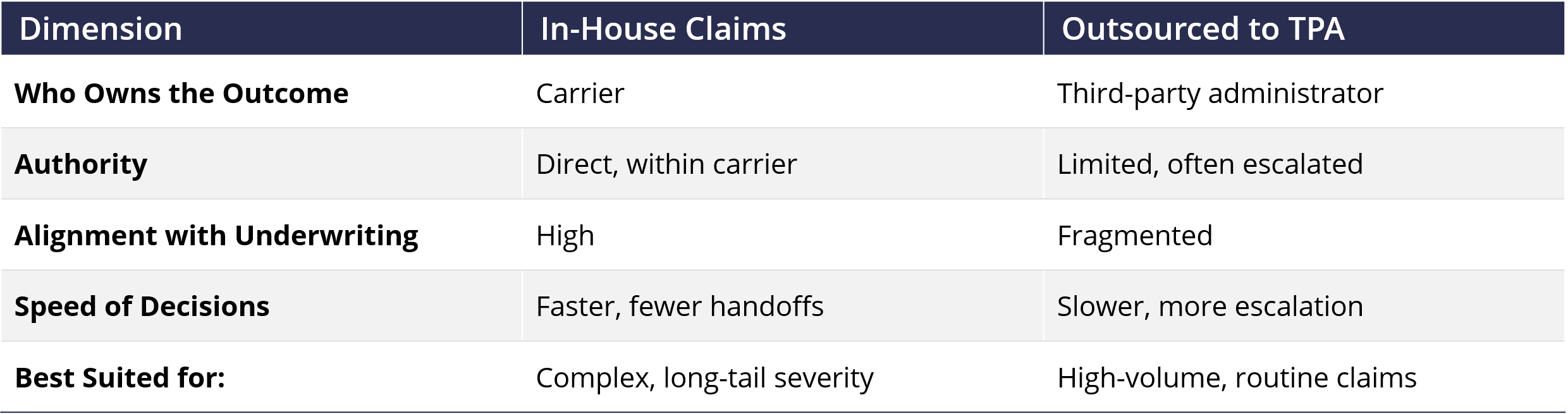
This is where the structural difference between carriers starts to show. When the carrier manages claims in-house, the same organization that underwrote the risk is responsible for managing the outcome. The people making decisions understand the original intent of the deal. They control reserves, legal strategy, and settlement posture without having to push decisions through layers of external approval. This structure can provide clearer accountability, and in most cases, faster, more consistent decision-making.
When claims are outsourced, maintaining that alignment can become challenging. Third-party administrators (TPAs), which handle claims on behalf of carriers, do not carry the balance sheet. Their authority is defined by contract, and when a claim becomes complex, decisions often need to be escalated back to the carrier. That introduces friction right when speed and clarity matter most, and when the margin for error is the smallest.
For straightforward, high-volume claims, that model can work. For long-tail, high-severity losses, it tends to create more questions than answers. From a broker’s perspective, the distinction is simple. When things get complicated, you want the carrier directly engaged, not operating at arm’s length.
That distinction becomes clearer when you look at how the two models operate side by side:
These Two Factors Are Connected
Financial strength and claims management aren’t separate issues in practice. What happens on the claims side feeds directly into a carrier’s financial performance. If reserving is inconsistent or claims strategy lacks discipline or control, it shows up in loss development, earnings volatility, and eventually in capital strength. That, in turn, feeds directly into how rating agencies evaluate the company.
When a carrier keeps claims handling inside the organization, it is not simply an operational preference. It reinforces financial stability over time and supports the kind of consistency brokers rely on in longer-tail placements.
What This Means for You
When you’re building an excess placement, you’re doing more than assembling a tower. You’re making a call on which carriers you trust to show up when the claim is no longer theoretical and the easy decisions are gone.
It doesn’t always get said out loud, but it’s how experienced brokers think about it. Pricing matters, and terms matter, but those are starting points. The harder question is who has the balance sheet to stay consistent when conditions change, and who actually has the authority to make decisions when a claim starts to move in the wrong direction.
That’s where a carrier's approach to claims becomes important. When the carrier manages claims directly, you tend to get more continuity between underwriting intent and claims execution. Fewer handoffs, fewer gaps, and fewer situations where decisions stall out because the party in the room doesn’t have the authority to act.
It’s not something that shows up on a quote sheet, but it has a way of showing up later, when it matters most. What tends to separate carriers in practice is whether they bring both sides of this together. Strong paper on its own isn’t enough if claims management remains at arm’s length, and a good claims story doesn’t carry much weight without the balance sheet behind it. Bringing both inside the same organization, with clear authority and accountability, supports more consistent outcomes.
That’s why alignment between financial strength and claims control matters. It plays a central role in how a placement holds up when it’s tested.
That’s the model upon which Berkley Specialty Excess is built. We write on Admiral Insurance Company paper, member of W. R. Berkley Corporation, whose insurance company subsidiaries are rated A+ (Superior) by A.M. Best Company.
Our internal claims team has full authority. We assign a dedicated claims professional to each account, so brokers and insureds deal with the same person on every claim. Underwriting and claims sit inside the same organization, with clear authority behind both. That matters more when things get complicated than it does at bind.
In Conclusion
In E&S, the carrier is the product. The policy gets you in the door, but the balance sheet and the claims approach determine how things play out.
Financial strength tells you whether the carrier can pay. An in-house claims model demonstrates how the carrier will manage that process when it matters. When both are in place, the coverage is positioned to perform as intended. When they’re not, that gap can show up fast.
IMPORTANT INFORMATION
This article is for general informational purposes only and does not constitute insurance, legal, or risk management advice. Consult your broker and legal counsel for guidance specific to your organization.